Frozen Shoulder (Adhesive Capsulitis)

Frozen shoulder, also known as adhesive capsulitis, is a condition that causes increasing pain and stiffness in the shoulder. As the condition progresses, movement can become significantly restricted, making everyday activities such as dressing, reaching overhead or reaching behind the back difficult.

Unlike many other shoulder conditions, frozen shoulder is characterised by a progressive loss of both active and passive shoulder movement. This means movement is restricted not only when a person tries to move their own arm, but also when the shoulder is moved by someone else during an examination.

Frozen shoulder can sometimes develop without an obvious injury or cause. In other cases, it may occur following a period of reduced shoulder movement, such as after an injury or surgery. Certain health conditions are also associated with an increased risk of developing frozen shoulder.

The condition typically develops gradually and can persist for a prolonged period. Although frozen shoulder often improves over time, appropriate management can help control symptoms, maintain function and support the gradual recovery of movement.

In this guide, we’ll look at what frozen shoulder is, why it develops, its common symptoms and stages, how it is diagnosed, and the treatment and rehabilitation options available.
What Is Frozen Shoulder?

Frozen shoulder is a condition in which the capsule surrounding the shoulder joint becomes painful and progressively stiff, resulting in a significant reduction in shoulder movement.

The shoulder joint is surrounded by a flexible layer of connective tissue known as the joint capsule. Normally, this capsule allows the shoulder to move freely through its large range of motion. In frozen shoulder, changes within the capsule cause it to become thicker and less flexible, restricting movement of the joint.

A characteristic feature of frozen shoulder is the loss of both active movement — when a person moves their own arm — and passive movement — when the shoulder is moved by someone else. External rotation of the shoulder is often particularly restricted.

Frozen shoulder usually develops gradually rather than following a single traumatic event. Pain may be the dominant symptom initially, followed by increasing stiffness and difficulty performing everyday activities such as reaching overhead, putting on a jacket or reaching behind the back.

The term adhesive capsulitis is commonly used interchangeably with frozen shoulder. However, the condition is more complex than simply the formation of “adhesions”, and the extent of pain and stiffness can vary considerably between individuals.

Symptoms of Frozen Shoulder

Frozen shoulder typically develops gradually, with pain and increasing stiffness being the most characteristic symptoms. The severity and pattern of symptoms can change as the condition progresses.

Pain is often felt around the shoulder and may extend into the upper arm. In the earlier stages, pain can be significant and may occur both during movement and at rest. Night pain is common, and sleeping on the affected shoulder may become particularly uncomfortable.

As the condition progresses, stiffness often becomes more noticeable. People may find it increasingly difficult to lift the arm overhead, reach out to the side or rotate the shoulder.

Everyday activities can become challenging, including:

  • Putting on or removing a shirt or jacket
  • Reaching into a high cupboard
  • Washing or styling hair
  • Reaching behind the back
  • Fastening a bra or tucking in clothing
  • Putting on a seatbelt
  • Reaching into the back seat of a car
  • Sleeping comfortably on the affected side

One of the key features distinguishing frozen shoulder from many other shoulder conditions is that both active and passive movement become restricted. External rotation is commonly one of the most noticeably limited movements.

The amount of pain and stiffness can vary considerably between individuals and can also change throughout the course of the condition.

The Stages of Frozen Shoulder

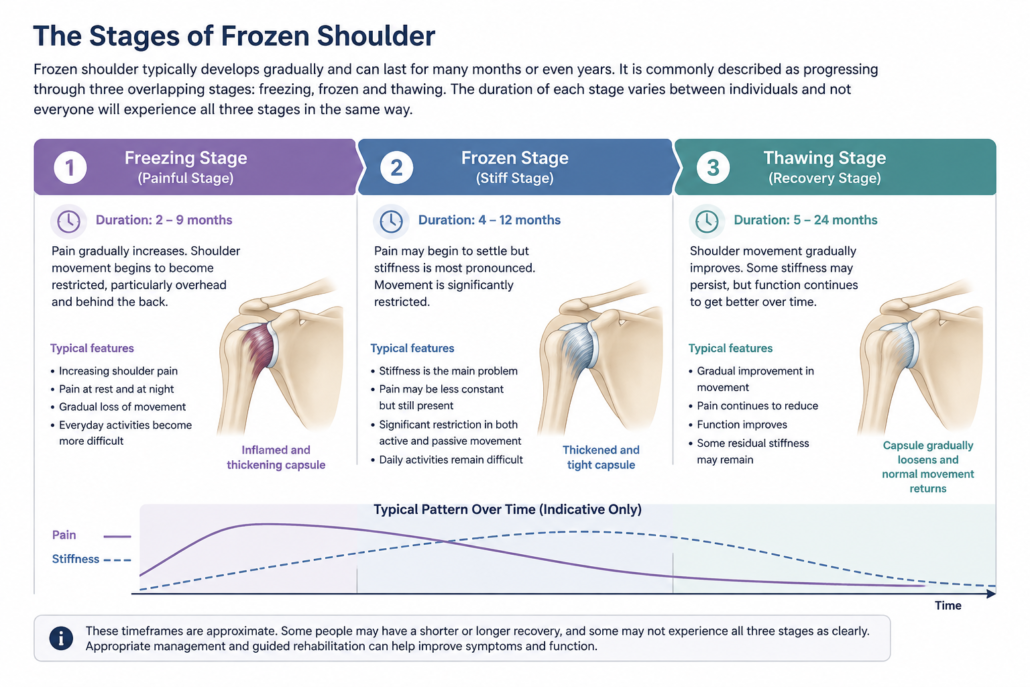
Frozen shoulder is commonly described as progressing through three overlapping stages: freezing, frozen and thawing. These stages describe how pain and stiffness often change over time, although the pattern and duration can vary considerably between individuals.

Not everyone progresses through three clearly defined phases, so the stages are best viewed as a general description of the condition rather than a fixed timeline.

Diagram showing the freezing, frozen and thawing stages of frozen shoulder, including changes in pain, stiffness and shoulder movement.

Freezing stage: Pain usually becomes increasingly prominent and shoulder movement gradually becomes more restricted. Night pain and pain with everyday movements can be particularly troublesome during this period.

Frozen stage: Pain may begin to settle, but stiffness and restricted movement often become the dominant problem. Activities involving reaching overhead, out to the side or behind the back can remain difficult.

Thawing stage: Shoulder movement gradually begins to improve and everyday activities become easier. Recovery can continue over an extended period, and the rate of improvement varies between individuals.

It is important to remember that these stages are not a precise timetable. Frozen shoulder varies considerably from person to person, and treatment should be guided by the individual’s symptoms, stage of the condition and functional limitations.