Rotator Cuff Injuries

The rotator cuff is a group of four muscles and their tendons that work together to help move and stabilise the shoulder. Because these tendons are involved in many everyday movements — from reaching overhead and lifting objects to exercise and sport — they can be affected by a range of injuries and conditions.

Rotator cuff problems can develop gradually through changes in the tendon over time, or occur more suddenly following an injury. Symptoms can include shoulder pain, weakness, reduced movement and difficulty with activities such as reaching overhead, lifting, dressing or sleeping on the affected side.

In this guide, we’ll look at the different types of rotator cuff injuries, why they occur, common symptoms, how they are assessed and the treatment and rehabilitation options available.
What Is the Rotator Cuff?

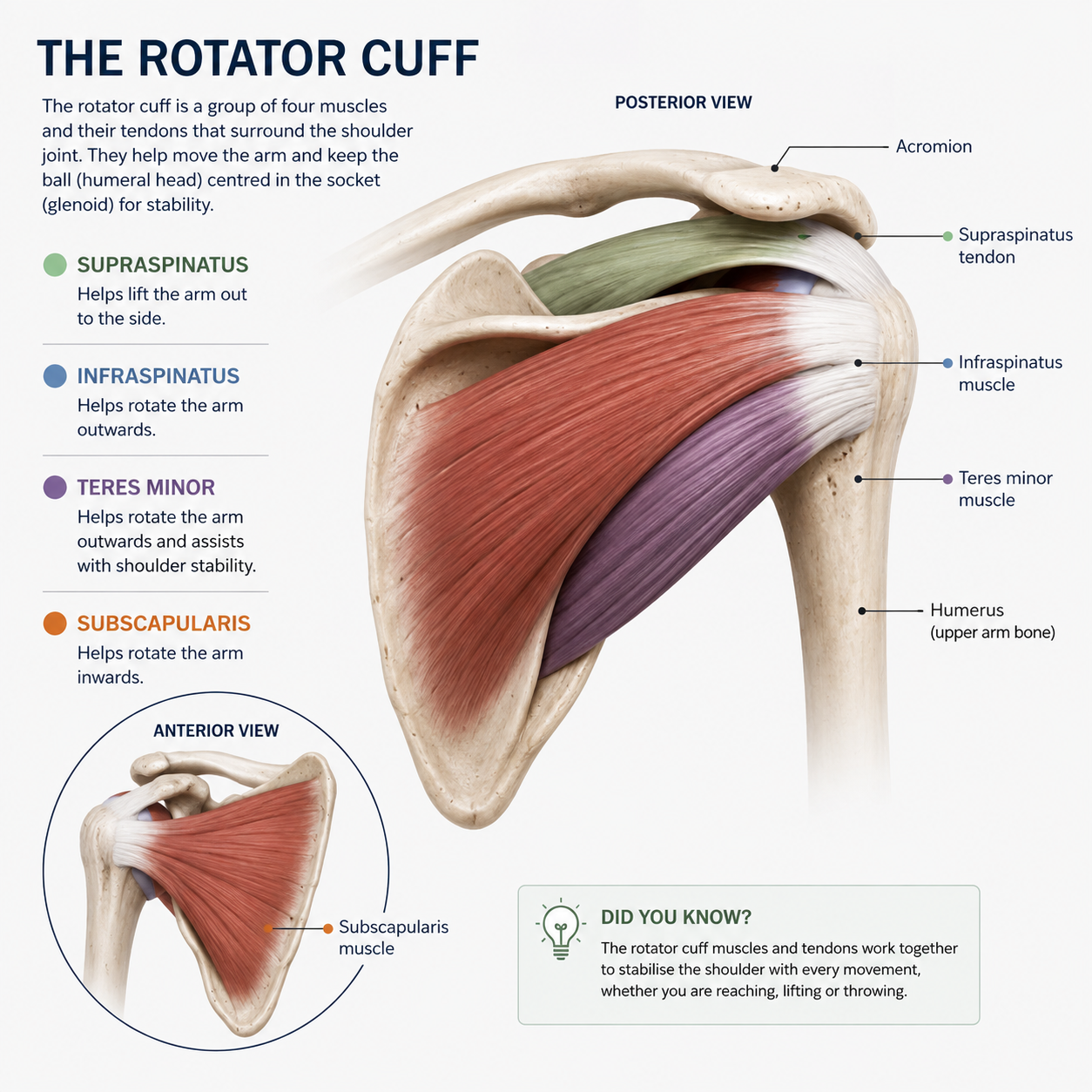
Rotator cuff anatomy showing the supraspinatus, infraspinatus, teres minor and subscapularis muscles and tendons

The rotator cuff is a group of four muscles and their tendons that surround the shoulder joint. Together, they help keep the head of the humerus (upper arm bone) centred within the shallow socket of the shoulder while also contributing to movement of the arm.

The four rotator cuff muscles are the supraspinatus, infraspinatus, teres minor and subscapularis. Each has a slightly different role, but together they are particularly important for controlling rotation of the shoulder and providing stability as the arm moves.

The tendons of these muscles attach around the head of the humerus, forming a cuff-like structure — which is where the name “rotator cuff” comes from. These tendons can be affected by age-related changes, repetitive loading or injury, leading to conditions ranging from tendinopathy to partial or full-thickness tears.

Types of Rotator Cuff Injuries

Rotator cuff injuries can affect the muscles themselves, but more commonly involve the tendons that attach the rotator cuff muscles to the humerus. These conditions exist on a spectrum, from changes within the tendon to partial or complete tears.

Importantly, changes seen on imaging do not always correspond directly with pain. Rotator cuff tendon changes and even tears can be present in people who have no shoulder symptoms, particularly as we get older. For this reason, imaging findings need to be considered alongside a person’s symptoms, strength, movement and clinical assessment.